
FIAT ELPIS
The AI cash test: OpenAI and Anthropic into 2028
Revenue is rising. So are the checks. Six scenarios show how much new capital the two labs may still need—and why their cash buffers change the answer.
FIAT ELPIS · Annual cash scenarios / 2027–28
Our base case puts OpenAI’s additional cash requirement at $57bn through 2028. Anthropic’s is $0—but it still spends $25bn of its existing cash buffer. The difference matters for the entire infrastructure trade.
A follow-up to The Neocloud Capex Trap · Research cut: 22 October 2026.
01 / THE ANSWER
Cash burn is only the first half of the question.
A lab can lose cash and still have years of runway. It can also report an attractive adjusted margin while writing enormous checks for research, reserved capacity and deposits. The investment question is what remains after those checks, the cash already raised, and a sensible liquidity reserve.

Under those central cash balances, the model requires no additional funding in 2027 in any of the six cases. That is an annual endpoint result, not proof that every month is funded. Companies may raise earlier to cover payment peaks, maintain larger buffers or protect themselves against a closed financing window.
These scenarios are not bounds: a revenue miss without spending restraint, or accelerated deposits, could be worse than the bear case. These are conditional estimates of total additional proceeds required, including any future facility draws. They are not estimates of equity issuance alone, or of the portion still uncommitted. Cash availability and supplier payment schedules are not disclosed well enough to make those stronger claims.
02 / BUILD THE CASH BRIDGE
Change the case. Follow the cash.
The calculation starts with assumed annual cash collections, deducts all compute cash payments, other cash costs and net new advances, then rolls the remaining cash into the next year. Run-rate revenue is not used as annual cash receipts.
Minimum year-end cash: $20bn.
Bar lengths share a dollar scale within the selected case. *Customer receipts are not verified ultimate-user cash: some customers may themselves be funded by investors.
See the complete annual cash bridge
| Cash item | 2027 | 2028 |
|---|
New funding = max(0, cash uses − customer receipts + minimum cash − opening usable cash).
Compute includes inference, training and reserved or idle capacity. We do not invent a training/inference split where no reconciled annual schedule exists. Net new advances represent extra cash tied up after credits for services consumed; they are not another charge for the same compute.
03 / THE MOST IMPORTANT UNKNOWN
How much of the money already raised is still usable?
Anthropic announced $30bn in February and $65bn in May. Those rounds include earlier strategic commitments; adding those investments again would double-count them. Reuters reported $20.28bn of cash and short-term investments at December 2025. The resulting $115.28bn arithmetic reference precedes 2026 cash uses, receipt timing and restrictions—not an available balance today.
OpenAI announced $122bn of committed capital in March. The Information reported roughly $40bn of cash and securities at year-end 2025. We do not add the full round to a later cash balance that already includes part of it. Amazon’s filed investment tranches demonstrate why that distinction matters.
We choose $100bn / $85bn of usable opening 2027 cash for OpenAI / Anthropic. These are modeling assumptions after 2026 spending and liquidity haircuts, not reported balances. The chosen floors are also assumptions. The chart tests how much the answer moves without changing a single operating forecast.

The facilities do not erase the economic bill. Amazon’s filing shows Anthropic’s $20bn facility reduced to $15bn after its Series H participation, with draw availability tied to compute milestones. Reuters describes an up-to-$42bn Broadcom facility with restrictions and no expected note issuance before an IPO. Neither is simply cash in the bank. A draw could satisfy part of our modeled financing requirement; it would not make that requirement disappear.
Supplier or chip-SPV financing is different again. If the lab pays leases already included in compute costs, the SPV’s borrowing is not an additional cash balance available to the lab. We also give no opening-cash credit to an uncompleted IPO.
04 / EVERY INPUT IS VISIBLE
Ambitious revenue. Expensive capacity.
Bear: adoption grows, but pricing pressure, open-model substitution and weaker paid conversion limit lab receipts. Capacity payments and deposits still ramp. Base: strong revenue growth with a substantial cash commitment to compute. Bull: much stronger revenue capture and better utilization; compute spending also rises, so revenue upside is not treated as free money.
OpenAI
| Input | Bear | Base | Bull |
|---|---|---|---|
| Annual revenue / receipts | 65 → 90 | 95 → 150 | 130 → 220 |
| Compute cash payments | 100 → 150 | 125 → 185 | 145 → 215 |
| Distribution fees | 0 → 0 | 0 → 0 | 0 → 0 |
| Other cash costs | 18 → 25 | 22 → 30 | 25 → 38 |
| Net new advances / deposits | 12 → 18 | 8 → 12 | 5 → 8 |
| Cash deficit (+) / surplus (−) | 65 → 103 | 60 → 77 | 45 → 41 |
| Fresh funding required | 0 → 88 | 0 → 57 | 0 → 6 |
Anthropic
| Input | Bear | Base | Bull |
|---|---|---|---|
| Annual revenue / receipts | 75 → 100 | 100 → 150 | 130 → 210 |
| Compute cash payments | 100 → 140 | 90 → 125 | 105 → 150 |
| Distribution fees | 7.5 → 10 | 10 → 15 | 11.7 → 16.8 |
| Other cash costs | 8 → 12 | 8 → 12 | 10 → 15 |
| Net new advances / deposits | 10 → 15 | 5 → 10 | 5 → 10 |
| Cash deficit (+) / surplus (−) | 50.5 → 77 | 13 → 12 | 1.7 → -18.2 |
| Fresh funding required | 0 → 57.5 | 0 → 0 | 0 → 0 |
OpenAI uses a net-of-distribution revenue basis; Anthropic uses gross revenue with a separate fee. In every case collections equal annual revenue. Other cash costs include payroll, non-compute operations, taxes, interest and direct non-compute capex. We give no separate credit for interest income on reserves. No undisclosed debt maturity schedule or intrayear payment peak is invented.
What anchors these choices?
OpenAI: Reuters’ September account of an FT-seen company presentation describes $278bn of cumulative negative FCF over 2026–30. It does not provide our annual split. Our base case burns $60bn in 2027 and $77bn in 2028. That is a scenario calibrated to the scale of the reported investment plan, not a claim to have reconstructed management’s budget.
Anthropic: the Dropbox SYZ note summarizes Q3 revenue of $16.8bn, reported positive quarterly cash flow and roughly $1.70 of revenue per dollar of compute. Those observations support a serious self-funding countercase, but do not reveal the annual payments for capacity coming online later. Reuters reported an earlier investor projection of $190–200bn of 2028 revenue; our $150bn base is below that projection.
Rittenhouse’s October 20 model estimates Anthropic compute payments of $86bn / $118bn in 2027 / 2028. We use $90bn / $125bn in the base case, plus distribution, other costs and new deposits. Its schedule is an independent estimate, not a filed payout table. Its $200bn-plus cash claim also assumes a $100bn IPO; that is fresh financing, not proof that the company is already funded.
Our Anthropic base is conservative on cash economics. Compute payments absorb 90% / 83% of annual revenue, much more than the approximately 59% implied by the reported Q3 ratio. This assumes newly available capacity and research spending run ahead of monetization. The reported quarterly ratio is not a reconciled annual cash-payment measure. As an illustrative sensitivity, holding compute at 59% instead would reduce two-year compute cash costs by about $68bn and turn the base $25bn deficit into roughly $43bn of cash generation, before other changes. That is a meaningful way this model could be too bearish.
05 / FOLLOW THE DOLLAR
Several invoices. One economic chain.
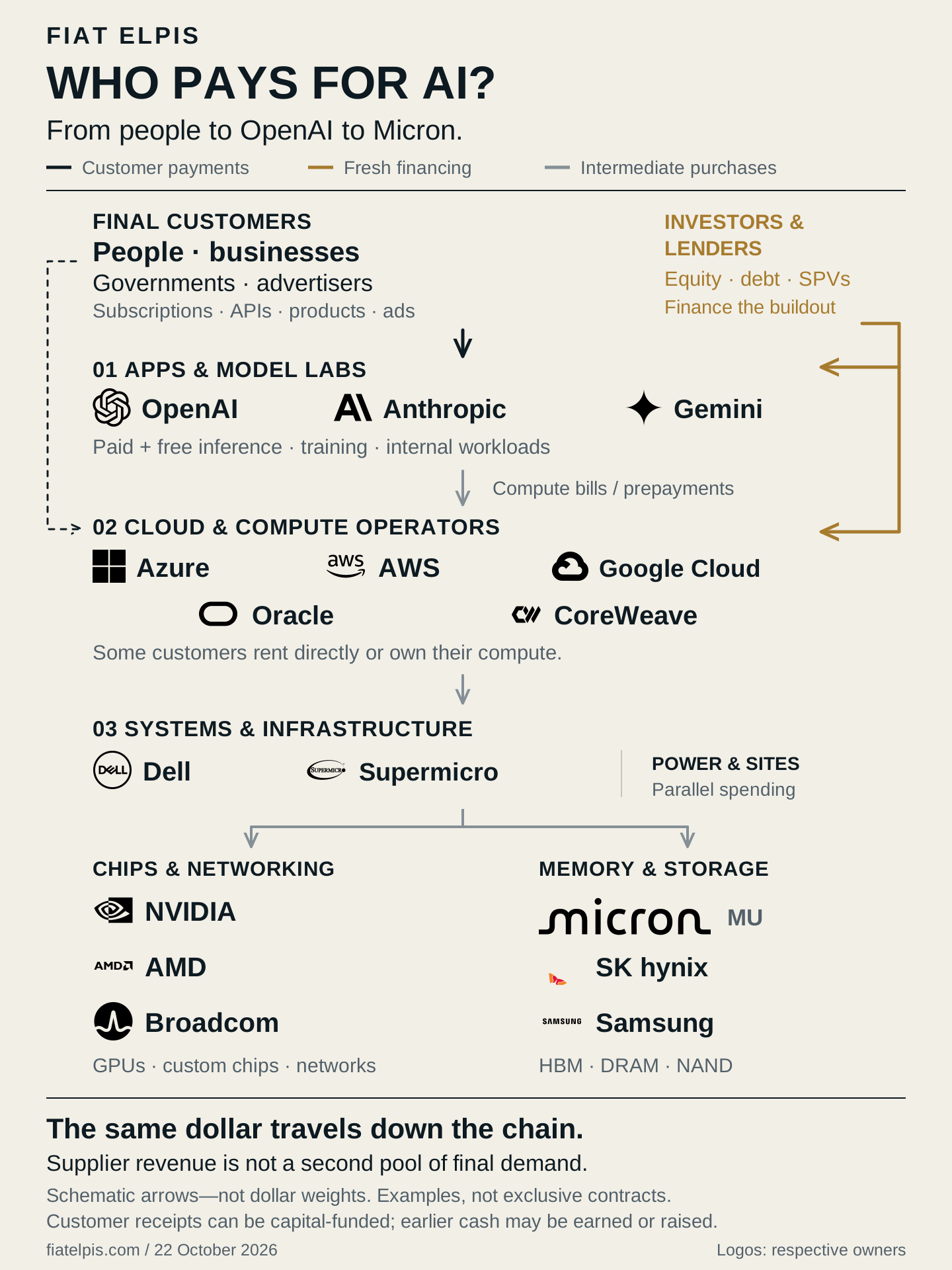
Schematic relationships; arrows here do not represent measured dollars or specific contracts. The annual cash bridge above is the quantitative view. Open models and owned infrastructure can bypass the lab layer.
A financed lab can pay an operator, which then reports operating cash inflow. That does not prove the chain is funded by ultimate users. Equally, adding the lab’s compute expense, the operator’s revenue and the chip maker’s sales produces multiple counts of the same spending.
This is why we do not add our lab funding estimates to a neocloud deficit and call the result an industry funding gap. A consolidated calculation would need to eliminate those transfers, reconcile periods and identify the original source of cash.
06 / THE INVESTMENT TEST
Growing AI use does not guarantee growing lab cash flow.
Aurelion’s October 22 field research, highlighted by P Equity, describes businesses getting real productivity gains while considering open models and owned hardware. That challenges how much value the labs retain. Its anonymous interviews are useful hypotheses, not a representative market-share or cost survey.
The underlying Vercel data offer a counterweight: open models took 71.5% of tokens but 23% of estimated spend, while frontier-model spending rose tenfold since December. Open and closed usage often grew together. This is one gateway’s panel, with spending estimated at list prices; neither token share nor a falling spend share proves falling absolute lab revenue.
P Equity’s expert-call relay about upfront neocloud payments supports testing cash timing. It does not justify applying the same prepayment percentage to every contract. We also do not deduct an unverified “distillation” percentage from reported revenue and then deduct it again from already lower forward assumptions.
What this changes for CoreWeave and Oracle
The supplier risk is a lab slowing its build-out, renegotiating timing or facing more expensive funding before end-user cash catches up. It is not necessary for the technology to fail. Goldman’s October 19 CoreWeave model already assumes $26.6bn / $20.0bn of net borrowing in 2027 / 2028. Those are forecast funding sources, not proof of drawable facilities.
But the buffers are real enough to matter. We cannot infer imminent defaults from a large multiyear commitment number. We also cannot convert this model into a blanket short on chip suppliers: a shift from closed APIs to owned hardware can hurt lab value capture while preserving demand elsewhere.
The decisive disclosures are straightforward: unrestricted cash; collected revenue on a consistent gross/net basis; annual cash payments for inference, training and committed capacity; required deposits; and facility draw conditions. Until those are reconciled, the honest conclusion is a range.
Our base conclusion: OpenAI remains dependent on substantial additional capital to maintain the modeled program. Anthropic can bridge 2027–28 without a compulsory new raise in this model, but still needs strong growth to avoid consuming its cushion. Neither result, by itself, justifies a valuation or guarantees that all suppliers earn their cost of capital.
Evidence, method and downloads
R = reported disclosure or reporting. F = attributed forecast. A = our assumption or calculation. C = commentary / external model. Every 2027–28 scenario input on this page is A; citations calibrate the choices rather than certify them.
We reviewed the relevant Dropbox research available through October 19, public filings and reporting, plus X posts from AurelionRsch and pequityresearch between September 21 and October 22. The account selection is not a representative survey. No reconciled annual cash-payment schedule or current unrestricted cash balance was found for either lab.
- R · Company financing: OpenAI, March 31; Anthropic Series G and Series H. Announced rounds are not current unrestricted cash.
- R · Financing terms: Amazon Q2 2026 10-Q, Note 2; Reuters, October 1, Broadcom facility.
- R · Historical cash: Reuters, September 28, Anthropic prospectus; The Information, June 16, OpenAI cash history.
- F · Company plans as reported: Reuters / FT, September 18, OpenAI five-year plan; Reuters, August 14, Anthropic 2028 revenue projection.
- R / F · Dropbox research: SYZ, Anthropic Q3 Results, October 15, pp. 2–4, summarizing financial reporting; Goldman Sachs, CoreWeave: Upgrade to Buy, October 19, p. 2, forecast cash-flow table. These are secondary research and analyst estimates, not audited annual lab cash flows.
- C · Independent countercase: Rittenhouse Research, October 20. Annual contract timing and IPO proceeds are its assumptions.
- C / R · Demand and cash timing: Aurelion, October 22; Vercel, October 15; P Equity, October 20 expert-call relay.
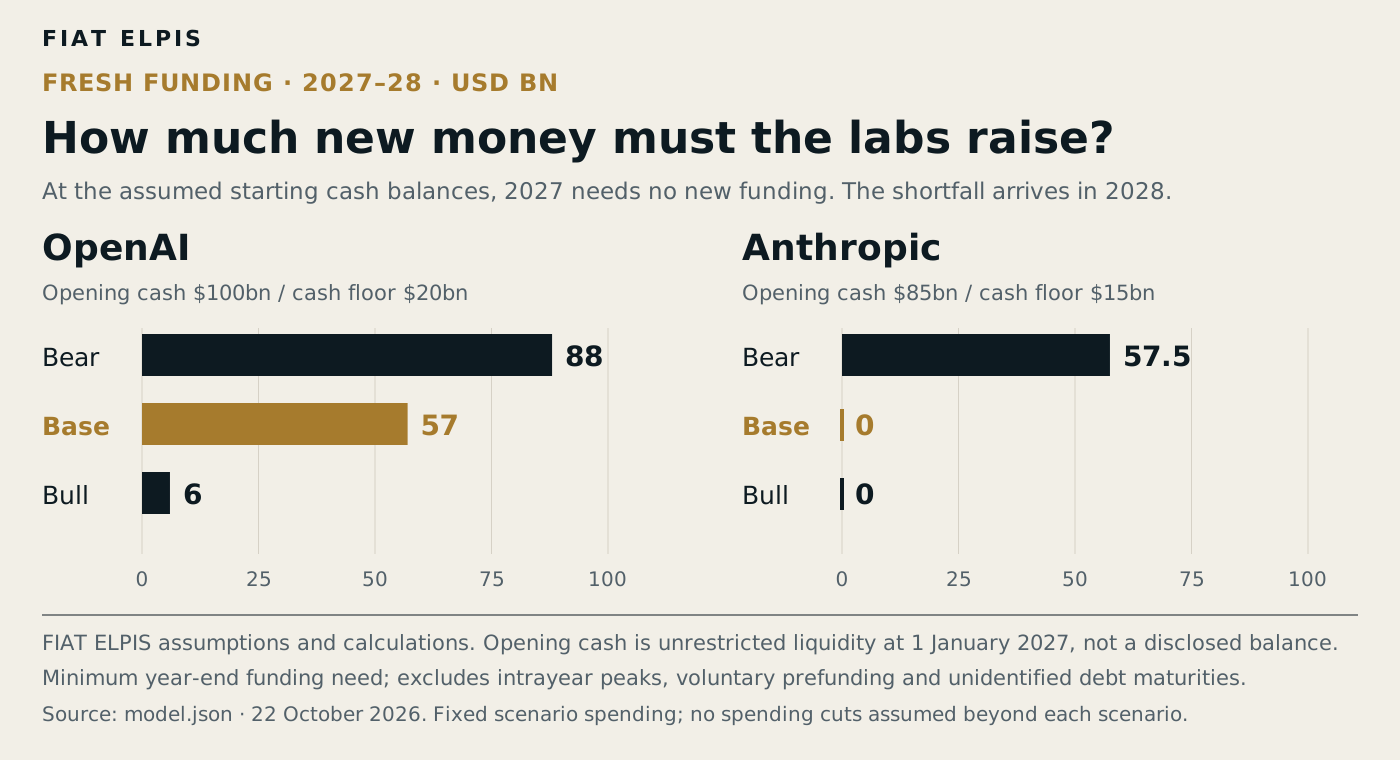
Illustrative scenario research, not a claim to know private-company budgets. Funding figures are rounded and not probability-weighted. Hero photograph: Brett Sayles / Pexels, illustrative server room, not a facility attributed to either lab.