
Fiat Elpis · Semiconductors and equity markets note 28
The Nasdaq-100 fell 19%. What happened to earnings three years out?
Three-year-forward earnings rose every week of the selloff. Nvidia’s guidance already absorbs the direct China hit. Offshore GPU rentals are the harder exposure to price.
Fiat Elpis research note
Seven weeks of rising earnings estimates
From October 2 to November 20, the Nasdaq-100 fell from 30,808 to 25,029. Over those same eight Fridays, estimated earnings per share for the rolling third year rose 7.8%. Investors went from paying about 15.4 to 11.6 times those distant earnings. Most of the selloff was already under way before the November 16 chip announcement.
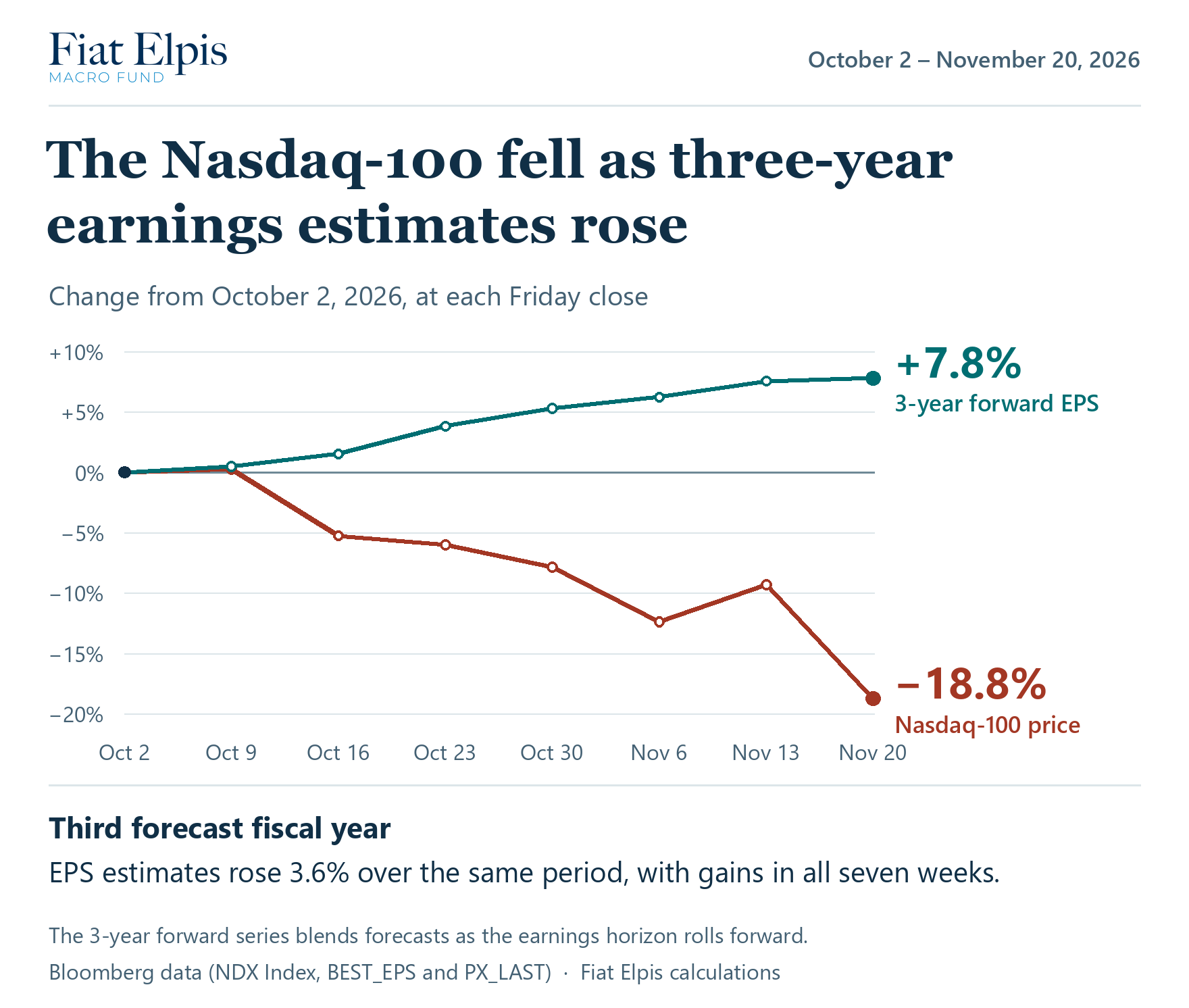
A rolling earnings estimate can rise simply because the forecast window advances into a stronger year. A second measure reduces that effect. The estimate for the third forecast fiscal year rose 3.6%, from 1,831 to 1,898 index earnings points. It rose in all seven intervals too. Both series measure what analysts expected at the time. The multiple can fall further if investors demand a higher return to own those earnings.
Four chip restrictions and where they bite
- Direct sales to China and Macau. The U.S. requires licenses for covered advanced chips. Eligible Nvidia H200 and AMD MI325X sales to China receive individual review. Nvidia has also described Chinese authorities discouraging purchases of its data-center chips. A U.S. license alone cannot secure a sale. U.S. licensing policy · Nvidia filing
- Chinese customers renting offshore compute. Effective November 19, covered hardware for overseas data centers providing significant computing capacity to companies based or ultimately parented in China, Macau or other U.S. arms-embargo destinations faces a licensing requirement. Existing affected operators have 90 days to obtain a license to continue. A limited exception covers exclusively commercial recommendation systems. The immediate exposure is rental demand at those facilities. Nvidia has yet to quantify the sales at risk. Commerce rule, §744.24
- Five additional destinations. Brazil, Indonesia, Malaysia, Singapore and Thailand now require licenses for covered advanced-chip exports, reexports and local transfers. Eligible U.S.-headquartered customers and subsidiaries can receive shipments if reporting conditions are met. The risk is that specific orders slip or get cancelled. Treating all sales booked in those countries as lost would overstate it. Commerce rule, §742.6
- Foundries and chip packagers. Tighter checks apply to certain advanced designs. TSMC and Samsung reportedly paused some shipments for Chinese clients. China-headquartered customers accounted for 5% of TSMC’s third-quarter revenue across all products. The affected orders are a subset whose value has yet to be disclosed. Commerce rule · Shipment reporting · TSMC results
The November 20 threat of penalties for U.S. companies building data centers overseas was still a proposal as of November 22. It would create a separate risk if enacted. White House remarks
What Nvidia already counted
Nvidia shipped $2.4 billion of Hopper data-center products to China in its third fiscal quarter, or 2.1% of its $115.8 billion in revenue. Its $130 billion fourth-quarter revenue outlook assumes zero direct China data-center compute sales. Subtracting the $2.4 billion from that outlook again would count the same exposure twice. Future sales Nvidia might have won in China are a separate opportunity cost. Nvidia CFO commentary
On November 17, management said it had assessed the new controls and was still studying their effects. It raised its FY2028 revenue growth outlook from 70% to about 75%, citing demand and available supply. In the week to November 20, analysts lifted Nvidia’s consensus FY2028 earnings estimate from $15.91 to $16.61 a share, a 4.4% increase. Nvidia earnings call · Consensus EPS estimates
What would change the view
Our view is that the direct chip restrictions alone give little support to a near-20% index decline. The more consequential question is who takes the capacity if Chinese renters leave. If operators find new tenants at comparable prices, the loss to chip suppliers could be small. If clusters sit idle, rental rates fall and operators cancel GPU orders, today’s estimates leave room for cuts. Three-year forecasts also depend on AI profits materializing well beyond the next quarter.
Chart methodology
Fiat Elpis calculated percentage changes from eight historical Friday closes and contemporaneous Bloomberg estimates for the Nasdaq-100. The rolling measure is one year of expected earnings roughly 24–36 months ahead. Bloomberg’s historical API returns a distinct third-year blend, although its field guide documents index blends only through 12 months. We checked the result by blending the third and fourth forecast-year index estimates ourselves, weighted by the fraction of the year remaining at each observation. That calculation also returns a 7.8% gain. As a separate check, holding the November 13 QQQ share quantities constant, aggregate third-year earnings for the 99 share classes with estimates on all eight dates rose 6.6%. That basket covers more than 99% of the marked equity value throughout the window. The cross-check uses the third forecast fiscal year. Fiscal year-ends can differ by company. Prices are for the cash index and exclude dividends. Market data through November 20, 2026. Policy status through November 22. Nasdaq-100 price history · Bloomberg index reference